International Cooperation
Practical Measures to Consolidate relations and Regional
International Cooperation
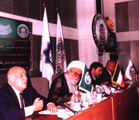
Tehran Islamic Summit Conference
Organization of the Eighth Islamic Summit Conference in Tehran which was inaugurated by the address of the Eminent Leader of the Revolution and the president of Iran was not only one of the most important events in the Post-Revolution history of Iran, buy in the last 50 years. Participation of great Islamic countries at the highest level in Tehran Conference created an opportunity for deliberation over the most important and sensitive issues of the Islamic world, namely, the Palestine question. The credit and dignity of Iran was
doubled for the organization of such a great conference in Iran. Tehran Conference annulled the efforts made by some powers to isolate Iran at the global level and to distort the message of the Islamic Revolution of Iran, and created an opportunity to prove to all that the national security and interests of the country have been more than ever strengthened. Preparations made for the organization of this great conference hoisting hundreds of high-ranking foreign guests, journalists and correspondents of global news agencies, and also building the conference venue in a very short time was a sing of the national capabilities of Iran and the will of the Iranian experts and specialists to perform outstanding tasks. Without doubt, such a valuable experience shall be regarded as a shining point to prove that the principle of self-reliance has flourished at all levels in Iran.
Relations with the Central Asian Countries and Caucuses
The collapse of the Soviet Union and the emergence of 15 independent republics have led to ample competition and opportunities in the region. It is after the creation of these republics that we can observe the growth of political and economic cooperation among the countries of the region. It is for the first time that we see the Commonwealth of Independent States plus Russia are having access to the Indian Ocean from the shortest routs. Along with the interest of the people to promote their relations, which is rooted in the history of their nations, some other unaccounted for relations have also emerged. For the changes taking place beyond the northern borders of Iran, a gap has appeared which cannot naturally remain unabridged forever. Henceforth, many foreign forces have ambushed for filling this gap, and if Iran was not conscious enough, they would gave used the opportunity to instigate instability throughout the northern borders of Iran. Iran could nor remain indifferent to what was going on at its northern borders and allows various paradigms jeopardize its national security. Iran could not immediately after the collapse of the security system of Russia sit back as an spectator, therefore, attached great significance to its foreign policy in the Central Asia and Caucuses and focused its full attention on the independence and territorial integrity and national sovereignty of these newly independent states and peace, tranquillity and security of the region. It is natural that Iran instead of pursuing its short term goals, prefers to think of long term prosperity that shall guarantee peace and stability of there of the region and shall serve as a means to further progress and development in the region.
At the outset, a lot was done to reflect a false picture of the goals and objectives of the foreign policy of Iran, to create suspicion and skepticism and to adversely affect the relations between Iran and the newly independent states, and attempt which fortunately remained abortive due to the consciousness of the people of the region and the historical, cultural and social similarities of the Central Asian countries and Caucuses with Iran. At present, cooperation between Iran and the regional countries is satisfactorily developing.
For its conviction of the following principles, Iran has formed a basic framework which is based on establishment of security, peace and stability in the neighboring states, namely the Persian Gulf and the Central Asian countries:
I. National security is an integral part of the regional peace, stability and security;
2. National security is an inseparable part of regional growth and development;
3. National growth is an indispensable segment of regional growth..
Attempts made by Iran for the consolidation of regional cooperation shall be constructive for all the people in the region. In other words, promotion of relations between
Iran, central Asian countries and Caucuses is a part of a natural trend stemming form the geographical and geopolitical status of Iran in the region.
Relations between Iran, Central Asia and Caucuses may be examined on the basis of three different principles, namely:
Bilateral Relations
Iran was among the first countries recognizing the independence of the former Soviet republics in all regional, international for and organizations. Iran enjoys full diplomatic relations with all Central Asian countries and Caucuses and has concluded a number of agreements in the political, economic and cultural fields. Some Iranian companies are now actively involved in investment in production, services, construction and agricultural sectors in this country. There are also direct flight routes between the capital cities of these republics and Tehran and other cities of Iran and the trucks are shuttling in large numbers through the Iranian highways and are interconnected to Turkey.
There are different forms for cooperation programs among Iran, Central Asian countries and Azerbaijan for the transfer of oil and gas, namely, transfer of natural gas from Turkmenistan to Europe through Iran, the program for using the Turkmenistans natural gas in the northern parts of Iran including in the Neka Power plant, cooperation of Iran in the so-called Azerbaijans king Denis program, transfer of natural gas of Iran to Nakhjavan and Armenia and later on to Georgia and Ukrain, and the Kazakhstan oil swap program.
Based on the recent studies, since Iran is linked through the Persian Gulf, the Oman Sea and its neighboring states, namely, Turkey and Pakistan to the outside world, therefore, it would be able to act as and oil and gas export terminal to Europe, the Subcontinent and the rest of the world. So allegedly Iran is the shortest, the most economical and safest rout for the transfer of raw material from the Central Asia to the consumers markets.
The gigantic oil facilities, namely, the oil transfer pipelines, the stations, terminals and the harbors in Iran all in all help Iran to become the main and the most easiest route for the transfer of oil.
Tripartite Relations
Tripartite relations is one of the unique arrangements in the bonds between Iran, Central Asian countries and Caucuses. The tripartite relations are arranged to bridge the existing gaps in the planned bilateral relation. Since their present economic structures stem from the centrally planned socialist system, the economy of the Central Asian countries and Caucuses are based on single products. Iran enjoying production of a variety of goods and a multi-dimensional economy can play a substantial role in connecting these economies whit others.
Regional Relations of Iran with the Central Asian Countries and Caucuses through Economic Cooperation Organization (ECO), and the Caspian Sea.
Cooperation Council
Iran is convinced that expansion of regional cooperation is the best instrument to promote peace, stability and security in the region, that is why Iran considers persuasion of regional cooperation as one of its main foreign policy objectives, the evidence of which is Irans initiative in establishing the ECO.
ECO as an organization pursuing such goals and objectives as development of trade, increasing the economic growth, and enhancing the common features of the member states plays a significant role in upgrading the presence of its member states in the world economy.
Iran is of the conviction that the efforts made by the ECO member states for removing the hurdles of development through consolidation of mutual cooperation and expansion of relations based on cooperation with other countries and international organizations can have a significant role in the promotion of regional stability and restoring international peace and security.
ECO can, on the one hand, cause greater affinity between the region and the Subcontinent, Central Asia, Southeast Asia and even the pacific rim, and, on the other, Iran as an important member of this organization is able to render or its required facilities and installations to connect them to the Persian Gulf and the Persian Gulf states in the south. Turkey, the other member of ECO can bridge the region to the Black Sea and Europe. Consequently, ECO acts as an axis interconnecting the group of countries from a number of directions. The central Asian countries without this axis cannot keep in touch with the outside world.
Irans other initiative is to establish the Caspian Sea Cooperation Council aimed at supporting the environment and having its resources exploited in an appropriate manner by the Caspian Sea littoral states. For the same purpose, Iran has reiterated the need for a detailed legal regime for the, Caspian Sea. Such a regime shall make the countries of the region able to solve their problems by themselves and to pave the way for regional cooperation. If such a regime is not agreed upon by the five Caspian Sea littoral states, there shall always be certain doubts and ambiguities that shall, in turn, rob the region from investment opportunities.
Dialogue of civilizations
United Nations General Assembly unanimously approved the proposal made by Iran to name the year 2001 as the year of " Dialogue among civilization" . Approval of this resolution in the greatest international organization is, without doubt, one of the most significant achievements of the foreign policy of Iran in the course of the two decades after the Islamic Revolution.
Iran, enjoying an ancient history, has proposed the dialogue among civilizations at a time when it has tasted the bitterness of war and the sweetness of peace. Primacy of dialogue and exchange of view over war and bloodshed is, indeed , the most basic principle of Irans foreign policy.
There is no doubt that the representatives of the countries in the UN have accepted the twenty first century as the century of "dialogue of civilization" for they have felt the global need for an opportunity to remove the curtains of ambiguity that gave led to cultural ruptures among the nation. This is the first and at the same time the most vital step towards "global understanding", without which "global peace" would be meaningless.
This proposal shall free the world community from the fear of war and bloodshed and render it tranquillity. Terror, fright, war and bloodshed shall be replaced by peace, tranquillity,
fraternity and altruism. In the light of such a logic the tolerance of the nations shall get enhanced and the countries shall continue with their cooperation peacefully.
[Introduction | Imposed War | Stability | Today | Culture & Art | Politics |
International Cooperation | Economy]