| |
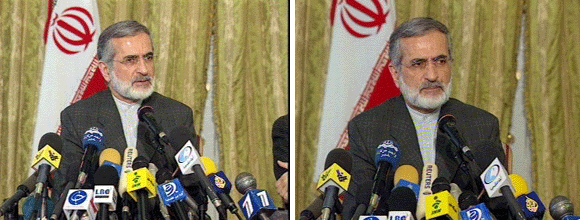
Tehran, Feb 18, IRNA -- Foreign Minister Kamal Kharrazi said here on Monday that United States decisions following the September 11 attacks have increasingly been arrived at unilaterally.
Addressing domestic and foreign journalists, he stressed that Washington is pursuing such attitude in decision-making in order to weaken the role of the United Nations (UN) and certain countries that seek a consensus in decision-making and thereby impose its will.
"While US President George W Bush talks of a coalition for war, President of the Islamic Republic Mohammad Khatami talks about a coalition for peace," he added.
Recent US decisions have unveiled to the world new facts on what her true intentions are, he said, adding that such facts have elicited international reaction against Washington's policies.
Recent US stances also reveal that Washington's claims of being a champion of democracy and its confrontation with so-called undemocratic governments are nothing but a pure joke, the FM reiterated.
Asked why the US president has made an affront to the Iranian nation by calling Iran as a nation with "dark history and ugly past"? Kharrazi responded, "We never describe the American nation with such
nomenclatures and the Iranian president always addresses with the Americans as 'the honorable American nation'. The main question is how Mr. Bush dares to insult the great Iranian nation?"
"The dark history and the ugly past concern what the United States has committed in Vietnam and Latin America and what the Central Intelligence Agency (CIA) has done in history, and the same continues with support for the brutality of the Zionist regime against the defenseless civilians in Palestine," he said.
The United States wants to sideline the rivals and exercise full domination on global affairs by lobbying for its unilateral views, Kharrazi said adding that it has decided to undermine the United Nations and the other nations to build a dictatorship at global level.
He said that while the Islamic Republic of Iran made every endeavor to help restore peace and stability in Afghanistan, the United States have charged Iran with interference in Afghanistan. The US wants to put pressure on Iran to distance itself from what is going on Afghanistan, he said.
"All admit that Iran played an important part in the establishment of peace and security in Afghanistan in coordination with the central (interim) government in Kabul. How is it possible for Iran to undermine a government in whose formation it has made great efforts and Iran's best friends are part of the government?" the Iranian foreign minister asked.
He outrightly dismissed any support from Iran to al-Qaeda and asked, "What is the ideological link between Iran and Taliban? Do we hold the same ideology the Taliban does? to help them after their defeat?"
Answering a question about possible infiltration of al-Qaeda elements into Iran, Kharrazi said perhaps some elements have infiltrated into Iran from Iran's long border with Afghanistan and Pakistan even though Iran has already reinforced border control in the area which led to the return home of those foreign nationals who had arrived in Iran with valid visas en route to Afghanistan. Several other people have been arrested along with their family members on the border for illegal entry into Iranian territory. Their identity are being established, he said.
"We have not identified any al-Qaeda elements from among those arrested. They included 40 women, 70-80 children and several men who have come from Europe and North Africa. The respective embassies in Tehran have been informed about them," he said.
He said that reconstruction of Afghanistan serves Iran's national interest adding that Iran's number one priority is to end poppy cultivation in Afghanistan. As along as the Afghan nation and government are keen on Iran's participation in Afghanistan's reconstruction efforts, Iran will be present in that country to help them.
He referred to the huge national rally in Iran on February 11 and said that though Iran pursues diversity in political spectrum and normally there is differences among the political parties, but, when Iran's national interests are being exposed to foreign threats, all exercise solidarity to defend national sovereignty.
He said that Iran's official stance is announced by the Supreme Leader, the president, foreign minister and the foreign ministry spokesman so that any comment by the military officers are their personal opinion.
He made it clear that Iran does not want tension and has already put forward the proposal of coalition for peace (by President Khatami at the UN General Assembly in New York last November).
He said that Iran has launched efforts to hunt down and bring to justice the human traffickers and those involved in possible infiltration of al-Qaeda elements into Iran.
Kharrazi termed the OIC-EU Forum held in Istanbul last week as an important event and said that the forum paved the way for dialogue of civilizations, and cultures.
He said that the forum's final communique emphasized the need for campaign against terrorism under the aegis of the United Nations in line with UN Resolutions which indicated that the Organization of the Islamic Conference (OIC) and the European Union (EU) dismissed the US unilateral approach in international campaign against terrorism.
He expressed pleasure with upgraded level of dialogue between Iran and the EU and said that Iran is keen to develop relations with the EU. Normally the EU doesn't agree with unilateral US policy and is opposed to imposition of unilateralism on Europe, he said.
Asked about the possibility of a thaw in Tehran-Washington relations, Kharrazi said that Iran's sincere efforts in Afghanistan and the United States reaction to it proved that the US is not reliable.
"Of course, we will revise our policy (toward US) in future by taking into account the US attitude towards Iran," he said.
He said that while the US Secretary of State Colin Powell voices Washington's willingness to talks to Iran, the US politicians should determine whether they have hoisted the flag of war with Iran or not. It is not right to make statement to threaten a country, on one hand, and pursue dialogue with that country, on the other, Kharrazi said.
A reporter asked whether rejecting the British ambassador will have impacts on Iran's relations with Britain, Kharrazi said, "Rejecting an ambassador is an normal routine in diplomatic relations, I had already notified Mr. Jack Straw, the British Foreign Secretary that Iran believes that the nominee for British ambassador to Iran is known in Iran as not being interested in boosting bilateral relations so Iran prefers that Britain nominate another ambassador to Iran."
On Iran's reaction to possible US attacks against Iran, Kharrazi said that that's just a theory. Iran is not Afghanistan. The Iranian nation are experienced enough to defend the country, as they did during the Iraqi-imposed war (1980-88), and are well-prepared to do that whenever they deem necessary.
On possible delay of a visit to Iran of the Chairman of Afghan Interim Government Hamid Karzai, he said that Mr. Karzai will visit Iran next week and there is no delay in this respect.
He said that Chairman Karzai's upcoming visit to Iran is an indication of Iran's firm support for the interim government and Iran's resolve to take part in reconstruction of Afghanistan.
Kharrazi said that Gulbuddin Hekmatyar (Afghan former premier) is living in Iran and will be free to leave the country whenever he decides to do so. As along as he lives in Iran, he is required to respect Iran's law and regulations, he said.
In response to a question about his upcoming visit to Moscow, he said that Tehran and Moscow hold the common views on international developments adding that he will hold talks with Russian officials on bilateral and regional issues and the US latest overture.
A reporter asked about developing relations with Iraq, Kharrazi said that the two countries still have problems left over from the eight years of war and have yet to settle past issues.
He said that Iran is against US military attack on Iraq and added that Iran holds a common view with regional countries that the United Nations should undertake the role to resolve the crisis peacefully and hoped that Iraq would honor UN resolutions.
He said that Iran is not mediating between Iraq and Kuwait on prisoners of war (PoWs) issue and only offered its experience to Kuwait on the same.
Kharrazi said that Iran is firmly developing relations with the Islamic and Arab nations to bring about consensus in the region in line with regional interests and reinforcing stability.
He said Iran has excellent relations with Saudi Arabia which is growing steadily.
Home
|
|