| |
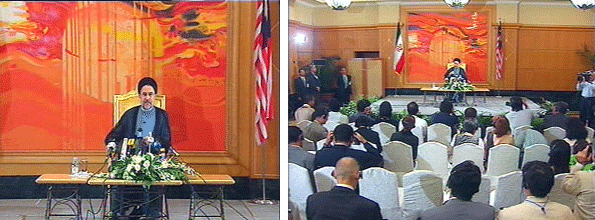
Kuala Lumpur, July 23, IRNA -- A three-day official visit to Malaysia is providing President Seyed Mohamad Khatami with a venue to explain issues and problems relating to Islam and terrorism to Malaysians and the international media.
In a one-hour press conference to wrapup his trip, he said: "It is important to explain...I hope that they will understand better after this explanation, that Islam is a religion of peace and does not promote terrorism."
The President also took pains to explain that the root causes of terrorism need to be studied and must be eliminated.
Among the many reasons, he pointed out, is that they (terrorists) have been left behind and they do not get justice as their countries are poor and weak.
Therefore, they do not have the capacity to take counter-measures." So, many Muslims act on their own, and this includes terrorism as they do not have other means of redress."
The president further said: "We do not sympathize with them (the terrorists), but it is important to understand why these people resort to such actions" that take innocent lives.
"If we do not understand, we will never be able to overcome the problem."
President Khatami accused the United States Tuesday of threatening and insulting his country and promoting war.
He also accused the US of steering the world into the frightening path of war.
"We live in a terrifying situation today; in the course of world history, we have never witnessed war being promoted as much as it is in the United States."
"The behavior of the US today is neither in the interest of the US nor of the world...today there are great threats against various nations and governments initiated by the US administration and in the long-term. This is a concern to all of us."
The president said the United Nations should lead the anti-terror war to remove the roots of terrorism, which he named as prejudice, discrimination, national humility and violation of human rights.
"I have proposed a coalition of peace based on justice against the US suggestion of a coalition of war...we should first have a good definition of terror and terrorism and then begin a basic campaign against it," he said He said Iran desires peaceful coexistence with other countries and would have no problem with the United States if it toned down its hostile rhetoric.
Khatami said the United States had interfered repeatedly in Iran's domestic affairs since the 1950s and that US. President George W. Bush's accusation that Iran was part of an "axis of evil," along with North Korea and Iraq, was unjust.
"The great nation of Iran has never tread on the path of evil," Khatami said.
"Evil is when a country has power and defines everything according to its own interests."
President Khatami said the US government was using the language of threats and insults against his country.
"The tongue and the language used by US administrators should change," he said.
"We are concerned about such a situation. Our world today can by no means accept military challenges especially when such challenges are initiated by a superpower with great military power," he said.
Presidenmt Khatami said that while terrorism was a "very horrifying and dangerous phenomena," US military actions in the aftermath of last year's terror attacks were misguided.
"Terror is a global issue and the entire world should be mobilized against it...but the war environment created today is very worrying," he said.
The President said Iran was opposed to a US attack aganist Iraq, a move widely anticipated and aimed at toppling its leader, Saddam Hussein.
"We condemn any foreign interference in Iraq," Khatami said. "Any interference in the domestic affairs of Iraq would be against the interests of the people of Iraq and the peace and tranquillity of the region and the world."
On the other issue, President Khatami said the proposed Islamic Union is aimed at uniting Islamic countries to pave the way for consolidation and progress of the Muslim world.
He said Muslims should benefit from the abundance of resources in the Islamic countries to be able to cope with today's world.
"If Islamic countries were to join hands, they can track the path of progress and development much faster at a lower cost.
"We should have sufficient strength to defend our right and identity and the basic strength is through knowledge and technology," he added.
Khatami arrived here late on Sunday for a three-day visit, his first to Malaysia. He is accompanied by a 91-member delegation, including cabinet ministers.
The current trip is Khatami's first to Malaysia since he was elected president in 1997. Former Iranian President Akbar Hashemi Rafsanjani visited Malaysia in 1994.
Later, addressing Malaysian and Iranian enterpreneurs, President Khatami called on the businessmen to invest further in his country in other fields, especially in new technologies.
He said Malaysian investment in Iran has the potential of increasing to more than 10-fold.
Khatami said the free zones and special economic regions of Iran could facilitate Malaysian investment, particularly in petroleum, gas, petrochemical, electronics, ICT, manufacturing, packaging, construction stone and tourism areas.
He said the vast gas, oil and mineral resources, the wide array of industrial activities, skilled human resources, political stability and security and diversity in climate have turned Iran into one of the most attractive markets in West Asia.
Iran's vast potential has also enabled it to create value-added activities, especially in the information and communications technology sector (ICT), he said.
"All these advantages have given our country strategic significance and these will certainly play an important role in establishing mutual relations regionally," Khatami said.
He also said Iran supported the valuable contribution of the Malaysian government toward integration of Asia, in the South-South cooperation and in the proposed Asian Monetary Fund initiative.
He said one of the most important and strategic policies of Iran was expanding and enhancing cooperation with Asian countries.
"We believe that such integration and cooperation would soon become inevitable," he said.
He went on to say that Iran can play a complementary role in giving impetus to the economies of many other Asian countries.
"We are keen to establishing relations with other Asian countries and to enhance cooperation between the Economic Cooperation Organization (ECO) and the ASEAN. And, along this line, expansion of cooperation between the two friendly and brotherly countries of Iran and Malaysia is a core policy and objective of Iran," the president said.
He also said that Iran is eager to share its experiences in the field of ICT (information and communications technology) by offering cooperation between both private and public sectors.
"In light of such valuable potential and considering the geographic positions of our two countries, I would like to suggest a joint collaboration called the `Trans-Asia IT Initiative' which calls for the establishment of a framework whereby a broad IT market can thrive," he added.
Khatami also emphasized that Iran's proper adaptation and management of modern technology, especially in the ICT sector, has helped his country achieve rapid economic growth.
Home
|
|