| |
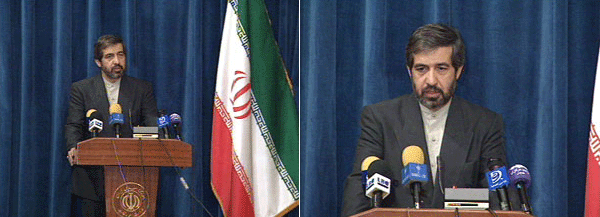
Tehran, March 4, IRNA -- Foreign Ministry spokesman Hamid Reza Asefi here Monday underlined that the Islamic Republic of Iran prefers the Caspian legal regime to be determined and implemented on the basis of general consensus of the five littoral states bordering the Sea.
Addressing a press conference, he told national and foreign journalists, "We have so far directed our attempts towards reaching an agreement and hope that others would work to the same end."
The five littoral states bordering the Caspian Sea comprise Iran, Russia, Kazakhstan, Turkmenistan and Azerbaijan.
Denying the rumors that Russian experts have left the Bushehr nuclear power station, he recalled that the number of the experts involved in the project is variable and might either decrease or increase depending on the type of their expertise.
He underlined that Iran-Russia joint cooperation is mainly aimed at peaceful goals and that there is no reason to block the project currently underway.
Referring to the date of the forthcoming visit of Iran's Foreign Minister, Kamal Kharrazi to Russia, he said that it would be followed up through diplomatic channels.
Commenting on the peace proposal of Saudi Crown Prince Amir Abdullah, he said, "There is no doubt about his good intention but as we have wintessed in the past the Zionist regime approaches every issue including the United Nation as a means."
He added that Prince Abdullah is a gifted, benevolent politician caring for the Palestinian people. He added that according to the predictions, the Zionist regime which opposes peace has more that once proved that it is not prepared to accept the world's general opinion and to secure the rights of the Palestinian people.
Asefi said that the policy of Ariel Sharon's government has failed and noted that the rate of the public support for him has reached the lowest possible and that his policies are even rejected by the Israelis themselves.
He referred to the return of the homeless Palestinians, the release of the Holy Qods, the evacuation of the occupied lands and letting the Palestinians determine their own fate as four fundamental and pivotal conditions for establishing any type of consistent peace in the Middle East.
Commenting on the fate and the new residence of Gulbuddin Hekmatyar, the Head of Afghanistan's Islamic Party, he said that he has no news on his latest whereabouts.
Concerning the statements attributed to Jordan's ambassador in Tehran who had accused Iran of interfering in the internal affairs of his country, he said, "The issue should be surveyed to verify its correctness and precision. We are not still in a position to comment in this respect and need to examine the issue."
Referring to the issues related to Tehran-London ties, he said that the issue concerning the ex-ambassador was a personal one and doesn't have anything to do with Iran-Britain relations.
Pointing to the favorable mutual relations over the past few months, he said that the Tehran-London ties have been expanding.
He added "Rejecting an ambassador is an acceptable diplomatic move and therefore the issue doesn't create any serious problem in Iran-UK mutual relations."
Pointing to the visit of Afghanistan's head of interim government, Hamed Karzai to Tehran as a fruitful one, he said that it has paved the way for the future cooperation between the two countries.
Concerning Karzai's meetings with the Leader of the Islamic Republic and President Khatami, he said that Iran is interested in the establishment of solidarity, security and tranquility in Afghanistan and that it looks forward to its development and independence. He added that in his opinion this would be realized if Afghanistan's interim government is supported.
Referring to Kharrazi's recent visits to Germany and Ireland, he said, "Various issues were on agenda and the ways of expanding Tehran-EU relations were discussed and its strengthening was underlined in both conferences held in Berlin and Dublin."
He concluded that the exchange of high-ranking delegations are expected to further contribute to mutual Iran-EU ties.
Home
|
|